|
|
| (488 intermediate revisions by 11 users not shown) |
| Line 1: |
Line 1: |
| [[File:icon-C++.png|64x64px]] C++ is a general purpose, cross-platform programming language with a vast user base.
| | {{#seo:|description=Learn how to use Phidget USB devices with C and C++.}} |
| | [[Category:Language]] |
|
| |
|
| __TOC__
| | == Get Started == |
| | With the Phidget22 library, it's easy to create C or C++ applications that work with Phidget devices. |
|
| |
|
| ==Support== | | == C Libraries == |
| | If you've installed the Phidget drivers for [[OS - Windows|Windows]], [[OS - macOS|MacOS]], or [[OS - Linux|Linux]], then you already have the files you need for your C project. |
|
| |
|
| {{LanguageSupport|C/C++|the complete Phidget API|all Phidget devices.|various Windows compilers (including Borland, Cygwin, and MinGW), Mac OSX, and Linux}}
| | ==== Windows Considerations ==== |
| | When adding directories for your project dependencies, add |
| | <syntaxhighlight> |
| | C:/Program Files/Phidgets/Phidget22 |
| | </syntaxhighlight> |
| | And for the linker, you can add |
| | <syntaxhighlight> |
| | C:/Program Files/Phidgets/Phidget22/phidget22.lib}} #(for 64-bit systems) |
| | C:/Program Files/Phidgets/Phidget22/x86/phidget22.lib}} #(for 32-bit systems) |
| | </syntaxhighlight> |
|
| |
|
| ==Quick Downloads== | | ==== MacOS Considerations ==== |
| | The Phidget framework will be found in |
| | <syntaxhighlight> |
| | /Library/Frameworks |
| | </syntaxhighlight> |
| | And the headers can be found in |
| | <syntaxhighlight> |
| | /Library/Frameworks/Phidget22.framework/Headers |
| | </syntaxhighlight> |
|
| |
|
| Just need the C/C++ drivers, libraries, and examples? Here they are:
| | ====Linux Considerations==== |
| | Linux restricts access to USB devices to the root user. |
|
| |
|
| C/C++ API Documentation: | | To run your C application as a regular user, you'll need to [{{SERVER}}/docs/OS_-_Linux#Setting_udev_Rules set up udev rules] on your system. |
| *[http://www.phidgets.com/documentation/Phidget21_C_Doc.zip C/C++ API Manual Download] or [http://www.phidgets.com/documentation/web/cdoc/index.html (HTML online version)]
| |
| *[[General API]] (more help on functions common to all Phidgets)
| |
| *[[Device List | Device Specific APIs]] (more help on functions specific to your Phidget)
| |
|
| |
|
| C/C++ Example Code:
| | === Library Files === |
| *[http://www.phidgets.com/downloads/examples/VCpp_2.1.8.20110615.zip C/C++ Example Code for Visual Studio]
| | If you would like to manually manage the Phidget22 library files, you can download them [https://cdn.phidgets.com/downloads/phidget22/libraries/windows/Phidget22-windevel.zip here]. |
| *[http://www.phidgets.com/downloads/examples/phidget21-c-examples_2.1.8.20110615.tar.gz Generic C/C++ Example Code]
| |
|
| |
|
| Libraries and Drivers:
| | == Development Environment Configuration == |
| *[http://www.phidgets.com/downloads/libraries/phidget21-x86_2.1.8.20110615.zip 32 bit Windows (drivers, with libraries)]
| |
| *[http://www.phidgets.com/downloads/libraries/phidget21-x64_2.1.8.20110615.zip 64 bit Windows (drivers, with libraries)]
| |
| *[http://www.phidgets.com/downloads/libraries/phidget21bcc_2.1.8.20110615.zip Borland C++ Libraries] (You also need one of the two Windows drivers above)
| |
| *[http://www.phidgets.com/downloads/libraries/libphidget_2.1.8.20111028.tar.gz General Linux Libraries] ([[OS - Linux | Linux Library Setup Instructions]])
| |
| *[http://www.phidgets.com/downloads/libraries/Phidget_2.1.8.20111103.dmg General Mac OSX Libraries] ([[OS - Mac OSX | Mac OSX Library Setup Instructions]])
| |
|
| |
|
| ==Getting started with C/C++== | | === GCC === |
| | {| style="margin:auto;" class="table-no-border mw-collapsible mw-collapsed" |
| | |+ '''Instructions''' |
| | | |
| | The most common tool for C development is GCC, whether used in the command line or through an IDE. GCC is packaged with many other IDEs and packages, so you may already have it installed. |
|
| |
|
| If you are new to writing code for Phidgets, we recommend starting by running, then modifying existing examples. This will allow you to:
| | {{hiddenh4|Windows}} |
| {{ExampleCodeReasons}} | | We recommend installing [https://www.cygwin.com/ Cygwin] or [https://sourceforge.net/projects/mingw/ MinGW], ensuring you select all gcc packages when prompted by the installer. |
|
| |
|
| Instructions are divided up by operating system. Choose:
| | To compile your code, go to the folder where your code is and open the command prompt by typing 'cmd' in the address bar. |
| *[[#Windows|Windows 2000 / XP / Vista / 7]]
| |
| *Linux (including PhidgetSBC)
| |
| *Mac OS X
| |
|
| |
|
| ==Windows== | | The specific command you will use depends on your compiler of choice: |
| | <syntaxhighlight lang=bash> |
| | #Cygwin x86: |
| | gcc example.c -o example -I"/cygdrive/c/Program Files/Phidgets/Phidget22"-L"/cygdrive/c/Program Files/Phidgets/Phidget22/x86" -lphidget22 |
|
| |
|
| *[http://www.phidgets.com/downloads/libraries/phidget21-x86_2.1.8.20110615.zip 32 bit Windows (drivers, with libraries)]
| | #Cygwin x64: |
| *[http://www.phidgets.com/downloads/libraries/phidget21-x64_2.1.8.20110615.zip 64 bit Windows (drivers, with libraries)]
| | gcc example.c -o example -I"/cygdrive/c/Program Files/Phidgets/Phidget22" -L"/cygdrive/c/Program Files/Phidgets/Phidget22" -lphidget22 |
|
| |
|
| C/C++ programs on Windows depend on three files, which the installers above put onto your system:
| | #MinGW: |
| * Phidget21.dll contains the actual Phidgets library, which is used at run-time. If you used our installer, it's already correctly placed in C:\Windows\System32. It can be manually installed - check our [[Manual Installation instructions]].
| | gcc example.c -o example -I"C:/Program Files/Phidgets/Phidget22" -L"C:/Program Files/Phidgets/Phidget22/x86" -lphidget22 |
| * Phidget21.lib is used by your compiler to link to the dll. Your compiler has to know where this file is. Our installer puts Phidget21.lib into C:\Program Files\Phidgets -Could be wrong-. Phidget21.lib is written to be compatible with most compilers - but your specific compiler may need a different format. Check our documentation for your specific compiler below for details.
| | </syntaxhighlight> |
| * Phidget21.h lists all the Phidget API function calls available to your code. Your compiler also has to know where this file is. By default, our installer puts Phidget21.h into C:\Program Files\Phidgets so you can either point your compiler to that location, or copy and link to it in a directory for your project workspace. We offer some instruction below, by compiler.
| |
|
| |
|
| Generally, to run the examples, you will download them and unpack them into a folder. If you browse around within the examples, you'll note that the examples are specific to each Phidget. So, you'll need to find the source code ''for your specific device'' within the example package.
| | After running the commands above for either Cygwin or MinGW, an executable file called example.exe will be created. Enter the following command to run the program: |
| | <syntaxhighlight lang=bash> |
| | example.exe |
| | </syntaxhighlight> |
| | {{hiddenh4|MacOS}} |
| | If you don't already have gcc installed, you can get it by installing [https://developer.apple.com/xcode/ Xcode]. |
|
| |
|
| When you are building a project from scratch, you will need to properly link the Phidget C/C++ libraries described above. Most compilers provide their own documentation on how to link external libraries. For some compilers, such as Borland and Dev C++, you will need to use different libraries. Please check your compiler section below to see if something specific is needed. Then, in your code, you usually need to include the Phidget library specifically:
| | To compile the program, enter the following command in the terminal, substituting "example" for the name of your C file: |
| | <syntaxhighlight lang=bash> |
| | gcc example.c -o example -F /Library/Frameworks -framework Phidget22 -I /Library/Frameworks/Phidget22.framework/Headers |
| | </syntaxhighlight> |
| | Finally, run the program by entering the following command in the terminal: |
| | <syntaxhighlight lang=bash> |
| | ./example |
| | </syntaxhighlight> |
| | Success! The project is now running with Phidgets. |
|
| |
|
| <div style="background-color: #f3f3f3; border-color: #1c9edb; border-width:1px; border-style: dashed;"> | | {{hiddenh4|Linux}} |
| <font size="3"> | | On Linux, gcc is installed through the package manager: |
| <source lang=cpp> | | <syntaxhighlight lang=bash> |
| | apt-get install gcc |
| | </syntaxhighlight> |
| | To compile the program, enter the following command in the terminal, substituting "example" for the name of your C file: |
| | <syntaxhighlight lang=bash> |
| | gcc example.c -o example -lphidget22 |
| | </syntaxhighlight> |
| | After compiling, you can run the program by entering the following command in the terminal: |
| | <syntaxhighlight lang=bash> |
| | ./example |
| | </syntaxhighlight> |
| | Success! The project is now running with Phidgets. |
| | |- |
| | |} |
|
| |
|
| #include <phidget21.h>
| | === Visual Studio === |
| | {| style="margin:auto;" class="table-no-border mw-collapsible mw-collapsed" |
| | |+ '''Instructions''' |
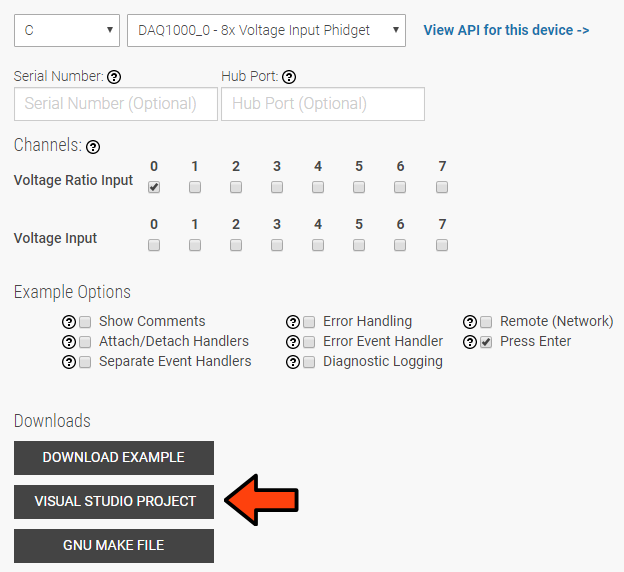
| | | If you want to jump right into a pre-configured project, you can download one on our [https://www.phidgets.com/?view=code_samples&lang=C Code Sample Generator] page. || [[Image:Language_C_VSProject.jpg|center|link=https://cdn.phidgets.com/docs/images/f/f1/Language_C_VSProject.jpg|350px]] |
| | |- |
| | | To configure a new project, follow these steps. || |
| | |- |
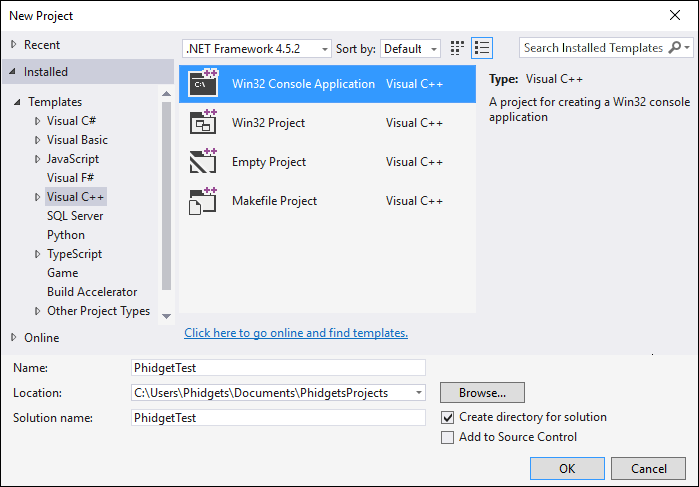
| | | First, create a new Win32 Console Application: || [[Image:Language_C_VS_step1.jpg|center|link=https://cdn.phidgets.com/docs/images/a/a1/Language_C_VS_step1.jpg|350px]] |
| | |- |
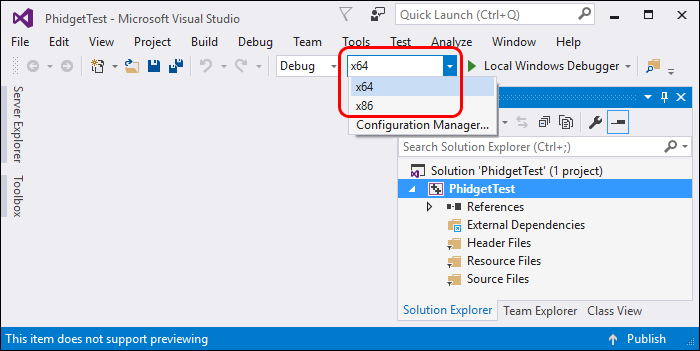
| | | If you are using a 64-bit machine, select x64, otherwise, select x86: || [[Image:Language_C_VS_step2.jpg|center|link=https://cdn.phidgets.com/docs/images/6/6b/Language_C_VS_step2.jpg|350px]] |
| | |- |
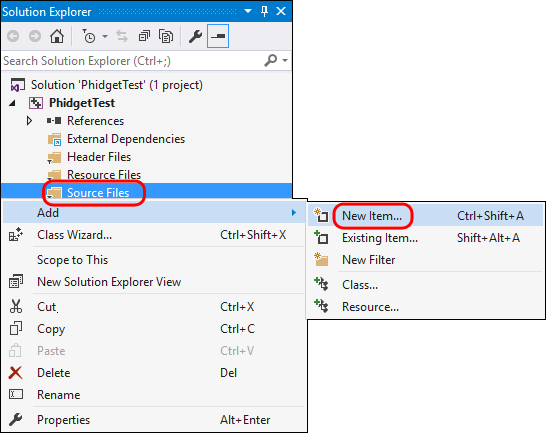
| | | Next, right click on the source folder and click New Item: || [[Image:Language_C_VS_step3.jpg|center|link=https://cdn.phidgets.com/docs/images/e/e1/Language_C_VS_step3.jpg|350px]] |
| | |- |
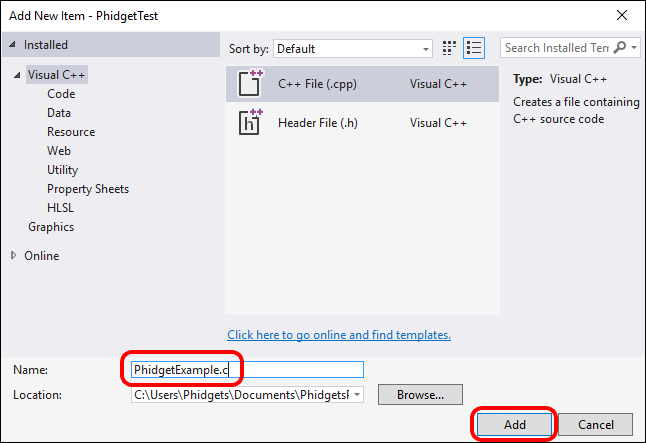
| | | Give the source file a name and click Add: || [[Image:Language_C_VS_step4.jpg|center|link=https://cdn.phidgets.com/docs/images/e/e5/Language_C_VS_step4.jpg|350px]] |
| | |- |
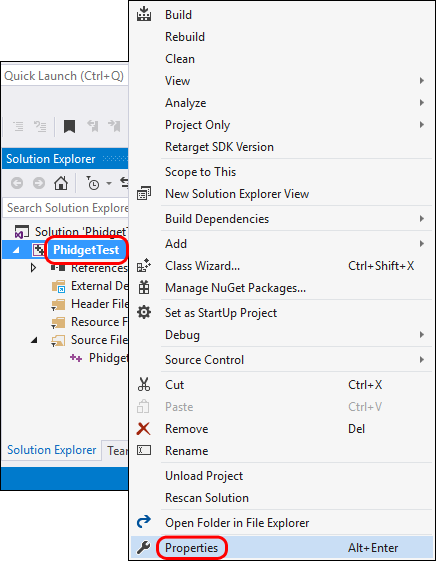
| | | Right click your project and access its properties: || [[Image:Language_C_VS_step5.jpg|center|link=https://cdn.phidgets.com/docs/images/1/1e/Language_C_VS_step5.jpg|350px]] |
| | |- |
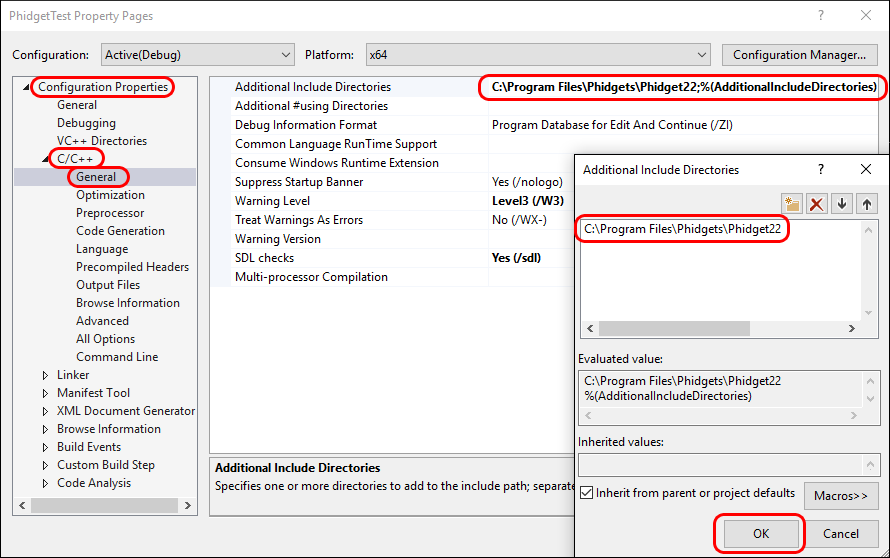
| | | Go to Configuration Properties -> C/C++ -> General and add this to the additional include directories: |
| | <syntaxhighlight> |
| | C:\Program Files\Phidgets\Phidget22 |
| | </syntaxhighlight> |
| | || [[Image:Language_C_VS_step6.jpg|center|link=https://cdn.phidgets.com/docs/images/d/d3/Language_C_VS_step6.jpg|350px]] |
| | |- |
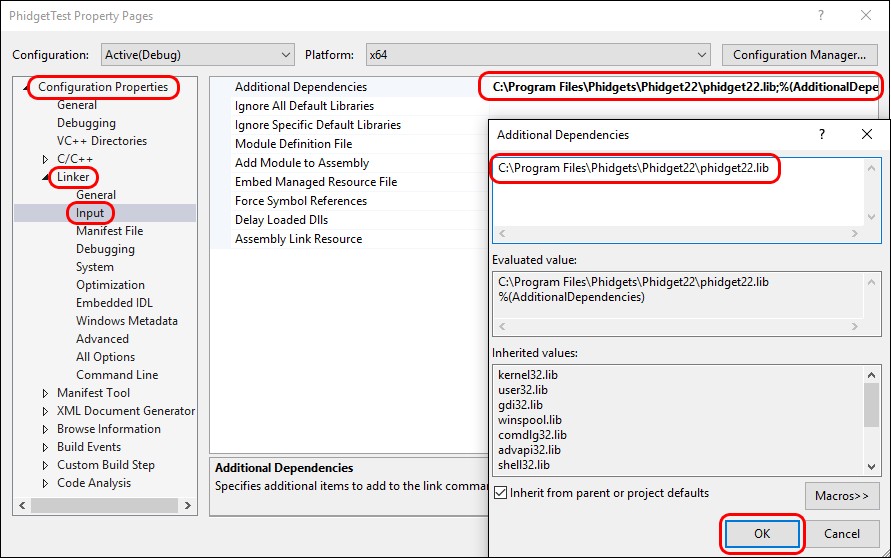
| | | Go to Configuration Properties -> Linker -> Input and add the appropriate line to additional dependencies: |
| | <syntaxhighlight> |
| | C:\Program Files\Phidgets\Phidget22\phidget22.lib #(for 64-bit systems) |
| | C:\Program Files\Phidgets\Phidget22\x86\phidget22.lib #(for 32-bit systems) |
| | </syntaxhighlight> |
| | || [[Image:Language_C_VS_step7.jpg|center|link=https://cdn.phidgets.com/docs/images/0/09/Language_C_VS_step7.jpg|350px]] |
| | |- |
| | | Lastly, include the Phidget library at the beginning of your program: |
| | <syntaxhighlight lang=bash> |
| | #include < phidget22.h > |
| | </syntaxhighlight> |
| | || |
| | |- |
| | |} |
|
| |
|
| </source> | | === PhidgetSBC Web Interface === |
| </font> | | {| style="margin:auto;" class="table-no-border mw-collapsible mw-collapsed" |
| </div>
| | |+'''Instructions''' |
| | |<center>{{#ev:youtube|2hTlVexctqY|rel=0}}</center> |
| | |} |
|
| |
|
| ===Visual Studio=== | | == Example Code == |
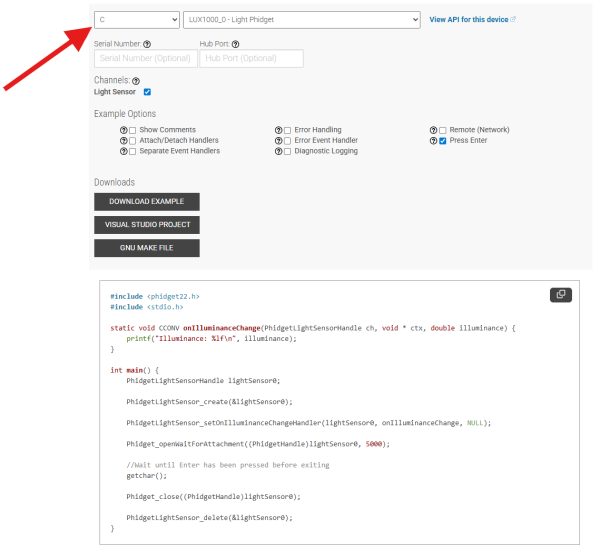
| | Navigate to our [https://www.phidgets.com/?view=code_samples&lang=C Code Sample Generator] to view and download code samples that are tailored to your specific device. |
|
| |
|
| *[http://www.phidgets.com/documentation/Phidget21_C_Doc.zip C/C++ API Reference]
| | [[Image:Language_c_codesample2.png|center|600px|link=]] |
| *[http://www.phidgets.com/downloads/examples/VCpp_2.1.8.20111028.zip Microsoft Visual C/C++ Examples]
| |
|
| |
|
| | ===Phidget Programming Basics=== |
| | {{PhidgetProgrammingBasicsLink}} |
|
| |
|
| | | ==API== |
| ====Visual Studio 2010====
| | [{{SERVER}}/?view=api&lang=C Phidget22 API] |
| | |
| | |
| | |
| | |
| ====Visual Studio 2008====
| |
| | |
| ====Visual Studio 2005====
| |
| | |
| ====Visual Studio 2003====
| |
| | |
| ====Visual Studio 6====
| |
| | |
| | |
| | |
| ===Borland===
| |
| | |
| *[http://www.phidgets.com/documentation/Phidget21_C_Doc.zip C/C++ API Reference]
| |
| *[http://www.phidgets.com/downloads/libraries/phidget21bcc_2.1.8.20110615.zip Borland C++ Libraries] (You also need one of the two Windows drivers above)
| |
| | |
| ===GCC on Windows===
| |
| | |
| *[http://www.phidgets.com/documentation/Phidget21_C_Doc.zip C/C++ API Reference]
| |
| *[http://www.phidgets.com/downloads/examples/phidget21-c-examples_2.1.8.20111028.tar.gz Generic C/C++ Examples]
| |
| | |
| | |
| ====CygWin====
| |
| | |
| | |
| ====MinGW====
| |
| | |
| | |
| ===Dev C++===
| |
| | |
| | |
| *[http://www.phidgets.com/documentation/Phidget21_C_Doc.zip C/C++ API Reference]
| |
| *[http://www.phidgets.com/downloads/examples/phidget21-c-examples_2.1.8.20111028.tar.gz Generic C/C++ Examples]
| |
| | |
| | |
| | |
| | |
| | |
| | |
| {{ContentNeeded|These Windows sections below need additional information}} | |
| | |
| ===General Windows Library Setup===
| |
| | |
| | |
| | |
| In addition to actually creating code to drive your Phidget,
| |
| | |
| | |
| ===Visual Studio C++ Library Setup===
| |
| | |
| To link libraries in Visual C++ 2005:
| |
| | |
| * Generate a new C/C++ console project with a descriptive name such as PhidgetTest.
| |
| * Open the project properties window.
| |
| * Navigate to Configuration Properties | C/C++
| |
| * Add "C:\Program Files\Phidgets" to the additional directories field.
| |
| * Navigate to Configuration Properties | Linker | Input.
| |
| * Edit the additional dependencies and add "C:\Program Files\Phidgets\phidget21.lib".
| |
| | |
| The project now has access to the Phidget21 function calls and you are ready to begin coding.
| |
| | |
| ===Borland C/C++ Library Setup===
| |
| | |
| To link libraries in Borland C/C++:
| |
| | |
| Make sure to download the additional Borland-specific libraries in addition to the drivers you already have through the ''Getting Started'' page [[Device List | for your device]]:
| |
| *[http://www.phidgets.com/downloads/libraries/phidget21bcc_2.1.8.20110615.zip Borland C++ Libraries]
| |
| | |
| To compile and link your program:
| |
| bcc32 -I"C:\Program Files\Phidgets" -L"C:\Program Files\Phidgets" phidget21bcc.lib example.c
| |
| | |
| ===MinGW Library Setup===
| |
| | |
| To compile and link your program:
| |
| gcc example.c -I"C:\Program Files\Phidgets" -L"C:\Program Files\Phidgets" -lphidget21
| |
| | |
| ===Cygwin Library Setup===
| |
| To compile and link your program:
| |
| gcc example.c -I"/cygdrive/c/Program Files/Phidgets" -L"/cygdrive/c/Program Files/Phidgets" -lphidget21
| |
| | |
| ===Dev C++ Library Setup===
| |
| In order to control Phidgets with Dev-C++, the library file will need to be in a format that Dev-C++ accepts, as described in the following steps. The following steps works with Dev-C++ 4.9.9.2.
| |
| Download the reimp tool(Please download it here), and type the following command to create libphidget21.a.
| |
| <br/>
| |
| <div style="background-color: #f3f3f3; border-color: #1c9edb; border-width:1px; border-style: dashed;">
| |
| <font size="3">
| |
| <source lang=bash>
| |
| reimp.exe "C:\Program Files\Phidgets\phidget21.lib"
| |
| </source>
| |
| </font>
| |
| </div>
| |
| | |
| Place libphidget21.a in <Dev-Cpp Install Directory>/lib
| |
| <br/>
| |
| Open up your project in Dev-C++, and traverse to Project Options->Parameters->Linker, and enter the following to link to the library: <div style="background-color: #f3f3f3; border-color: #1c9edb; border-width:1px; border-style: dashed;">
| |
| <font size="3">
| |
| <source lang=bash>
| |
| -lphidget21
| |
| </source>
| |
| </font>
| |
| </div>
| |
| | |
| Next, the path to phidget21.h will need to be specified.
| |
| Traverse to Project Options->Directories->Include Directories, and add the path to the Phidget installation directory:
| |
| <div style="background-color: #f3f3f3; border-color: #1c9edb; border-width:1px; border-style: dashed;">
| |
| <font size="3">
| |
| <source lang=bash>
| |
| C:\Program Files\Phidgets
| |
| </source>
| |
| </font>
| |
| </div>
| |
| | |
| | |
| ==Mac OSX==
| |
| | |
| One good way to start developing your application is to run and modify existing examples. You can find the C/C++ API and example code here:
| |
| | |
| *[http://www.phidgets.com/documentation/Phidget21_C_Doc.zip C/C++ API Reference]
| |
| *[http://www.phidgets.com/downloads/examples/phidget21-c-examples_2.1.8.20111028.tar.gz Generic C/C++ Examples]
| |
| | |
| To run the example code, you'll need to find the source code ''for your specific device''. Then, compile the code under your platform and run it. This will allow you to:
| |
| {{ExampleCodeReasons}}
| |
| | |
| The examples assume that the compiled libraries have been set up properly.
| |
| * To set them up on Mac OSX, follow the ''Getting Started'' page for [[Device List | your specific device]]
| |
| | |
| To compile, link the Phidget libraries, and build an executable binary on MacOS, do (for example, depending on the Headers location):
| |
| | |
| <div style="background-color: #f3f3f3; border-color: #1c9edb; border-width:1px; border-style: dashed;">
| |
| <font size="3">
| |
| <source lang=bash>
| |
| gcc example.c -o example -framework Phidget21 -I/Library/Frameworks/Phidget21.framework/Headers
| |
| </source>
| |
| </font>
| |
| </div>
| |
| | |
| After using gcc, you will have an executable named <code>example</code> that you can run.
| |
| | |
| | |
| ==Linux==
| |
| | |
| One good way to start developing your application is to run and modify existing examples. You can find the C/C++ API and example code here:
| |
| | |
| *[http://www.phidgets.com/documentation/Phidget21_C_Doc.zip C/C++ API Reference]
| |
| *[http://www.phidgets.com/downloads/examples/phidget21-c-examples_2.1.8.20111028.tar.gz Generic C/C++ Examples]
| |
| | |
| To run the example code, you'll need to find the source code ''for your specific device''. Then, compile the code under your platform and run it. This will allow you to:
| |
| {{ExampleCodeReasons}}
| |
| | |
| The examples assume that the compiled libraries have been set up properly.
| |
| * To set them up on Linux, compile and install them as explained on the main [[OS - Linux | Linux page]]
| |
| | |
| To compile, link the Phidget libraries, and build a binary executable on Linux, do the following in a terminal in the directory with <code>example.c</code>:
| |
| | |
| <div style="background-color: #f3f3f3; border-color: #1c9edb; border-width:1px; border-style: dashed;">
| |
| <font size="3">
| |
| <source lang=bash>
| |
| gcc example.c -o example -lphidget21
| |
| </source>
| |
| </font>
| |
| </div>
| |
| | |
| After using gcc, you will have an executable named <code>example</code> that you can run. On Linux, if you have not set up [[OS - Linux | your udev rules for USB access]] you will need to run the program as root.
| |
| | |
| ==Follow The Examples==
| |
| | |
| By following the instructions for your operating system and compiler above, you probably now have a working example and want to understand them better so you can change them.
| |
| | |
| {{ExamplePseudocode|In C/C++, you can name these '''event''' functions whatever you like. You will then pass them as function pointers to the Phidget library below in the Main Code section. This hooks them into the actual events when they occur. <br>
| |
| In the example code, the event functions common to all Phidgets are called things like '''AttachHandler()''' and '''DetachHandler()''', etc.<br><br>
| |
| Some event functions will be specific to each device, like when a tag is read on an RFID board, or when a sensor value changes on an Interface Kit.
| |
| Other functions are given in the examples to show you more detail on using your Phidget. For example, '''DeviceInitialize()''' will show what needs to be set up for your Phidget before using it.
| |
| |Creating a Phidget software object in C is specific to the Phidget. For a Phidget Spatial, for example, this would involve creating an object with the <code>CPhidgetSpatialHandle</code> type, and then initializing it using the <code>CPhidgetSpatial_create</code> function. The examples show how to do this and other API functions.<br><br>
| |
| Other C calls follow a similar syntax - <code>CPhidgetXXX_function</code>, where XXX is the name of your device, and function is an action available from the API for your specific Phidget.
| |
| }}
| |
| | |
| When changing the examples to do what you want, or writing your own code, you will probably find these API resources useful because they outline the C/C++ functions that you can use:
| |
| | |
| {{UsingAPhidgetInCodeGeneral|both of which are available in C/C++|[http://www.phidgets.com/documentation/Phidget21_C_Doc.zip C/C++ API]}}
| |
| | |
| | |
| ==Getting Started (MacOS/Linux)==
| |
| | |
| ===Run The Examples===
| |
| | |
| One good way to start developing your application is to run and modify existing examples. You can find the C/C++ API and example code here:
| |
| | |
| *[http://www.phidgets.com/documentation/Phidget21_C_Doc.zip C/C++ API Reference]
| |
| *[http://www.phidgets.com/downloads/examples/phidget21-c-examples_2.1.8.20111028.tar.gz Standard C/C++ Examples for Linux/MacOS]
| |
| | |
| To run the example code, you'll need to find the source code ''for your specific device''. Then, compile the code under your platform and run it. This will allow you to:
| |
| {{ExampleCodeReasons}}
| |
| | |
| The examples assume that the compiled libraries have been set up properly.
| |
| * To set them up on Mac OSX, follow the ''Getting Started'' page for [[Device List | your specific device]]
| |
| * To set them up on Linux, compile and install them as explained on the main [[OS - Linux | Linux page]]
| |
| | |
| Compiling and linking against the Phidgets Library for the example code can be done in the following ways:
| |
| | |
| To build on Linux:
| |
| | |
| <div style="background-color: #f3f3f3; border-color: #1c9edb; border-width:1px; border-style: dashed;">
| |
| <font size="3">
| |
| <source lang=bash>
| |
| gcc example.c -o example -lphidget21
| |
| </source>
| |
| </font>
| |
| </div>
| |
| | |
| To build on MacOS (for example, depending on the Headers location):
| |
| | |
| <div style="background-color: #f3f3f3; border-color: #1c9edb; border-width:1px; border-style: dashed;">
| |
| <font size="3">
| |
| <source lang=bash>
| |
| gcc example.c -o example -framework Phidget21 -I/Library/Frameworks/Phidget21.framework/Headers
| |
| </source>
| |
| </font>
| |
| </div>
| |
| | |
| After using gcc, you will have an executable named <code>example</code> that you can run. On Linux, if you have not set up [[OS - Linux | your udev rules for USB access]] you will need to run the program as root.
| |
| | |
| ===Follow The Examples===
| |
| | |
| {{ExamplePseudocode|In C/C++ on Linux or Mac, you can name these '''event''' functions whatever you like. You will then pass them as function pointers to the Phidget library below in the Main Code section. This hooks them into the actual events when they occur. <br>
| |
| In the example code, the event functions common to all Phidgets are called things like '''AttachHandler()''' and '''DetachHandler()''', etc.<br><br>
| |
| Some event functions will be specific to each device, like when a tag is read on an RFID board, or when a sensor value changes on an Interface Kit.
| |
| Other functions are given in the examples to show you more detail on using your Phidget. For example, '''DeviceInitialize()''' will show what needs to be set up for your Phidget before using it.
| |
| |Creating a Phidget software object in C is specific to the Phidget. For a Phidget Spatial, for example, this would involve creating an object with the <code>CPhidgetSpatialHandle</code> type, and then initializing it using the <code>CPhidgetSpatial_create</code> function. The examples show how to do this and other API functions.<br><br>
| |
| Other C calls follow a similar syntax - <code>CPhidgetXXX_function</code>, where XXX is the name of your device, and function is an action available from the API for your specific Phidget.
| |
| }}
| |
| | |
| ==Write Your Own Code (Mac OSX/Linux)==
| |
| | |
| {{UsingAPhidgetInCodeGeneral|both of which are available in C/C++|[http://www.phidgets.com/documentation/Phidget21_C_Doc.zip C/C++ API]}}
| |
| | |
| ===General Mac OS/Linux Library Setup===
| |
| | |
| Before you can use the Phidget, you must include a reference to the library header.
| |
| | |
| <div style="background-color: #f3f3f3; border-color: #1c9edb; border-width:1px; border-style: dashed;">
| |
| <font size="3">
| |
| <source lang=cpp>
| |
| | |
| #include <phidget21.h>
| |
| | |
| </source>
| |
| </font>
| |
| </div>
| |
| | |
| ===Create and Build Your Project===
| |
| | |
| With the libraries linked properly in your compiler, you can consult the following resources for help with writing code:
| |
| *[http://www.phidgets.com/documentation/Phidget21_C_Doc.zip C/C++ API Manual Download] or [http://www.phidgets.com/documentation/web/cdoc/index.html (HTML online version)]
| |
| *[[General API]] (more help on functions common to all Phidgets)
| |
| *[[Device List | Device Specific APIs]] (more help on functions specific to your Phidget)
| |
| | |
| * The page with [[General Phidget Programming | general programming concepts]] for Phidgets
| |
| | |
| | |
| Compiling and linking against the Phidgets Library can be done in the following ways:
| |
| | |
| To build on Linux:
| |
| | |
| <div style="background-color: #f3f3f3; border-color: #1c9edb; border-width:1px; border-style: dashed;">
| |
| <font size="3">
| |
| <source lang=bash>
| |
| gcc example.c -o example -lphidget21
| |
| </source>
| |
| </font>
| |
| </div>
| |
| | |
| To build on MacOS (for example, depending on the Headers location):
| |
| | |
| <div style="background-color: #f3f3f3; border-color: #1c9edb; border-width:1px; border-style: dashed;">
| |
| <font size="3">
| |
| <source lang=bash>
| |
| gcc example.c -o example -framework Phidget21 -I/Library/Frameworks/Phidget21.framework/Headers
| |
| </source>
| |
| </font>
| |
| </div>
| |
| | |
| ==Development Environments and Compilers==
| |
| | |
| Describe each major compiler and notable differences or important information. (eg. framework versions) If there are known issues/workarounds mention them and link to the corresponding issue at the bottom of the page.
| |
| | |
| {{ContentNeeded|This section may or may not be covered in the different compilers sections above in Getting Started (Windows), and the common problems below? If so, delete this section.}}
| |
| | |
| <b>Dev C++</b><br/>
| |
| In order to control Phidgets with Dev-C++, the library file will need to be in a format that Dev-C++ accepts, as described in the following steps. The following steps works with Dev-C++ 4.9.9.2.
| |
| Download the reimp tool(Please download it here), and type the following command to create libphidget21.a.
| |
| <br/>
| |
| <div style="background-color: #f3f3f3; border-color: #1c9edb; border-width:1px; border-style: dashed;">
| |
| <font size="3">
| |
| <source lang=bash>
| |
| reimp.exe "C:\Program Files\Phidgets\phidget21.lib"
| |
| </source>
| |
| </font>
| |
| </div>
| |
| | |
| Place libphidget21.a in <Dev-Cpp Install Directory>/lib
| |
| <br/>
| |
| Open up your project in Dev-C++, and traverse to Project Options->Parameters->Linker, and enter the following to link to the library: <div style="background-color: #f3f3f3; border-color: #1c9edb; border-width:1px; border-style: dashed;">
| |
| <font size="3">
| |
| <source lang=bash>
| |
| -lphidget21
| |
| </source>
| |
| </font>
| |
| </div>
| |
| | |
| Next, the path to phidget21.h will need to be specified.
| |
| Traverse to Project Options->Directories->Include Directories, and add the path to the Phidget installation directory:
| |
| <div style="background-color: #f3f3f3; border-color: #1c9edb; border-width:1px; border-style: dashed;">
| |
| <font size="3">
| |
| <source lang=bash>
| |
| C:\Program Files\Phidgets
| |
| </source>
| |
| </font>
| |
| </div>
| |
| Your program will now have access to Phidgets
| |
| | |
| | |
| ==Manual Install==
| |
| <b>Windows</b>
| |
| <br/>
| |
| Files needed: phidget21.h, phidget21.lib, phidget21.dll
| |
| These files should be linked to Library Page - file section
| |
| <br/>
| |
| Place phidget21.dll into C:\WINDOWS\system32.
| |
| phidget21.h and phidget21.lib can be placed anywhere as long as the path to them are specified with your compiler
| |
| | |
| ==Common Problems and Solutions/Workarounds==
| |
| | |
| Here you can put various frequent problems and our recommended solutions.
| |